
01
Organize
Organize submitted site addresses, acreage, IT demand, and project assumptions.
DCFR — KNOW BEFORE YOU COMMIT.
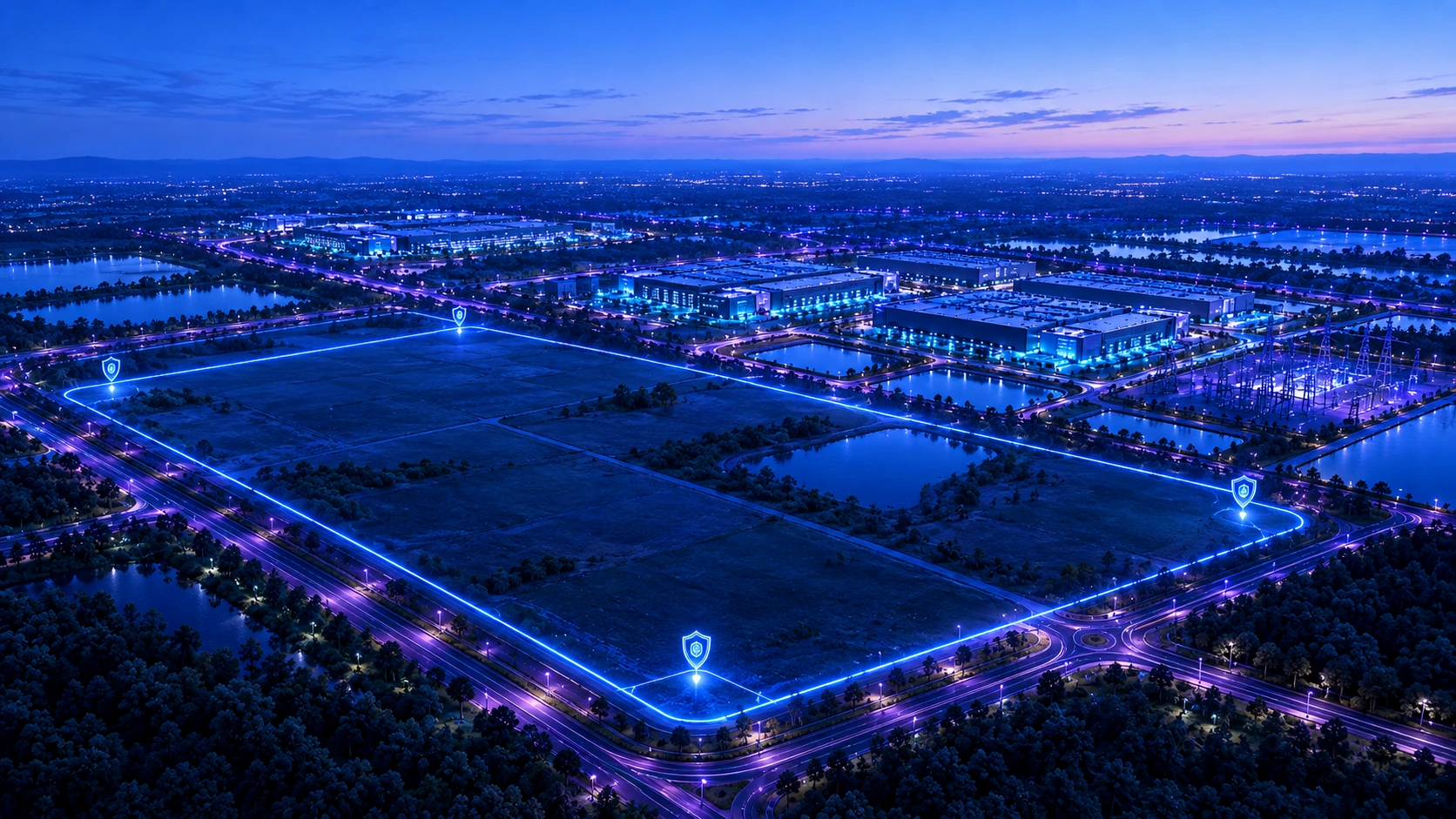
Planning intelligence for early data center decisions. Compare submitted acreage and IT demand, review available public-source evidence, and identify the confirmations needed before you commit.
How it works
Submit up to 20 candidate sites and your project assumptions. DCFR compares area budgets, checks available public-source data, and records what needs further confirmation.
Organize submitted site addresses, acreage, IT demand, and project assumptions.
Calculate building, equipment-yard, and site-reserve budgets from stated planning assumptions.
Record available location, flood-zone, and point-elevation observations, source dates, and data gaps.
Compare candidate-site area budgets using the same stated planning assumptions.
Identify missing evidence and the utility, AHJ, survey, and design confirmations required.
Use preliminary estimates and unresolved risks to guide deeper professional diligence.
What you receive
Current automated reports provide area and demand estimates, available public-source observations, and confirmation actions across seven modules. Parcel geometry, utility capacity, permitted use, and engineered designs require project-specific confirmation.
Interactive sample
Choose a sample parcel, explore seven modules, and inspect the assumptions behind each finding.
Fictional sample data and prepared assumptions. No live parcel lookup or customer analysis. No account required.
Decision layer · not the full report
Use this dashboard to compare sites and navigate executive findings. Every finding in a completed DCFR report is supported by detailed analysis, source evidence, calculations, planning exhibits, risks, dependencies, and recommended actions.
01 · Select a sample site
02 · Compare planning assumptions
Module 02 · Sample Site A · Baseline
Carry the permitted-use, access, equipment-separation, and fire-water questions into the next diligence brief.
The complete module documents the supporting evidence, assumptions, constraints, and required verification actions.
| Decision input | Sample value | Basis |
|---|---|---|
| Permitted use | To confirm | Local zoning authority |
| Adopted code + amendments | Not assigned | Building / fire authority |
| Fire access + separation | To verify | Project-specific layout |
This executive finding is the decision summary. The full module provides the defensible record behind it.
Open decision gate: Utility service and flood exposure. A positive area balance does not confirm a buildable layout, utility service, or permission to develop.
Who it helps
Select your team to see an illustrative workflow, from the first question to the next deliverable.
Several parcels use different assumptions, so apparent capacity and project readiness are difficult to compare.
Apply a consistent program, compare the same seven modules, and change phasing or cooling assumptions before commissioning the next study.
A shortlist, scenario comparison, and coordinated consultant scope with unresolved gates visible.
Measure the value: Team hours per comparison cycle and time to agree the next diligence scope.
Estimate with your own numbers →Workflow value
Compare the same work over one billing month or one Project Pass. Use your own estimates to see the time and labor value needed to cover the software cost.
Use totals for one billing month. Match the workload to your plan allowances. View limits.
For the same screening and reporting workload.
Include input preparation, result review, and all remaining checks.
Your blended internal labor cost, including overhead.
Include purchased extra runs and any incremental data or software costs for this period.
Estimate from your inputs
Enter both time estimates and your hourly cost. Results will appear here; no savings assumption is preselected.
Hours released = current hours − hours with DCFR.
Net value = hours released × hourly cost − software and added costs.
ROI = net value ÷ software and added costs × 100.
This is a user-defined workflow estimate, not measured customer ROI or a savings guarantee. It excludes avoided acquisition losses, consultant-fee reductions, and construction savings. Professional diligence remains necessary. Prices are USD before applicable taxes; paid access availability follows the pricing page.
Architect-led planning logic
Built by Jeehee Hong, a New York State Registered Architect with 20+ years of experience across architecture, infrastructure, logistics, master planning, and mission-critical development in the US, Asia, and EMEA. DCFR structures that experience into repeatable planning questions, explicit assumptions, and clear next actions.
New York State Registered Architect
AIA Member · NCARB Record Holder · Data Center Certified Associate · LEED Green Associate
Jeehee’s background includes 100+ completed projects across high-rise mixed-use, residential portfolios, institutional and healthcare facilities, adaptive reuse, hospitality, commercial office, global retail, and large-scale integrated infrastructure — including AI-enabled smart logistics city developments totaling 16M SF / approximately $6B.
Across her career, she has contributed to more than $10B in accumulated project portfolio value, working across multidisciplinary teams, program governance, feasibility strategy, cost and schedule constraints, and technical coordination.
Expertise shapes the framework. Standard reports are software-generated. No individual architect or engineer review, seal, or approval is included.
See the methodologySite intelligence
Practical notes on the constraints and development choices behind a data center land decision.
Your next step
Start with candidate locations, approximate acreage, target capacity, and any development strategy you already have in mind. If you are still open, DCFR can evaluate the site without forcing a predetermined form.